
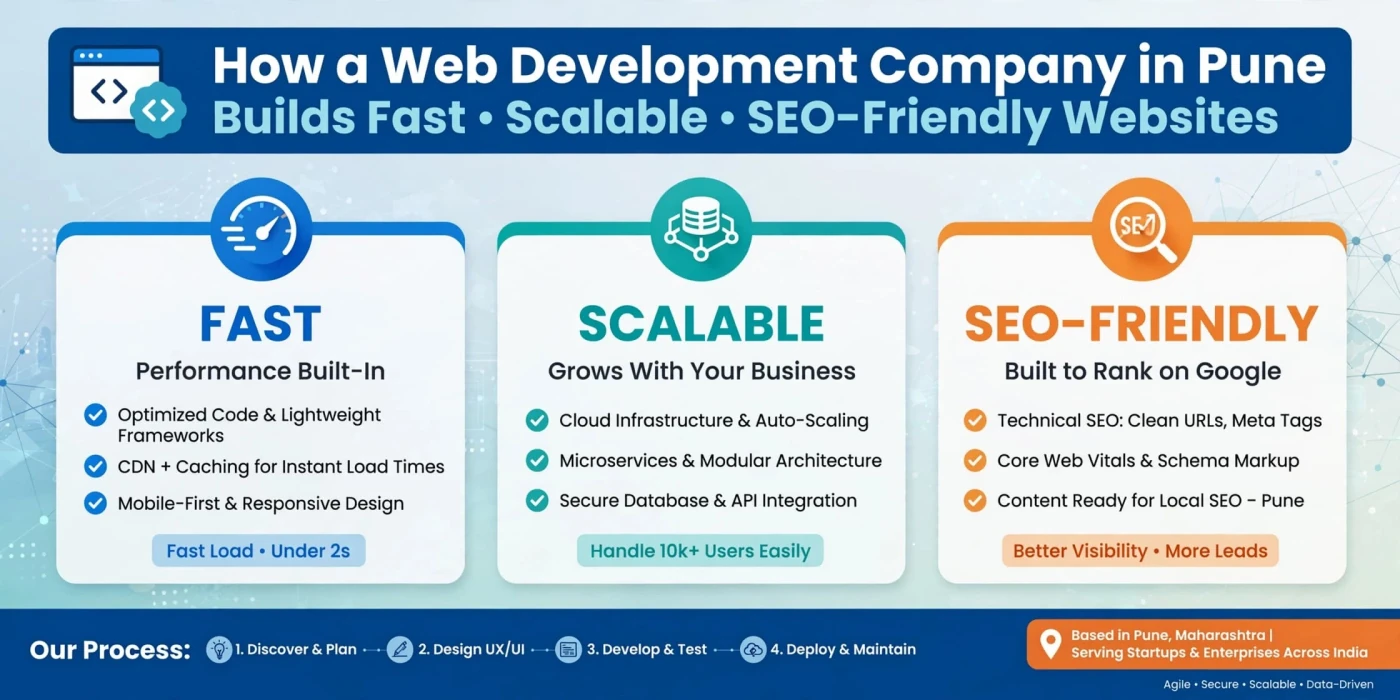
Speed, scalability, and search visibility aren't optional extras anymore — they're the baseline expectation for any business website. A slow-loading page or a poorly structured site doesn't just frustrate visitors; it actively pushes them toward competitors and quietly damages search rankings in the process.
Understanding how a web development company in Pune builds fast and SEO friendly websites requires looking beyond design trends and into the technical decisions made long before a single page goes live. Having worked on projects across industries, experienced development teams know that performance and search visibility aren't features added at the end; they're built into the foundation from day one.
1. Why Speed and SEO Can't Be Separated Anymore:
Search engines have made their priorities clear: user experience matters as much as content relevance. This is precisely how website performance affects SEO rankings. Google actively measures load times, interactivity, and visual stability as part of its Core Web Vitals, and sites that underperform here often get outranked by faster, better-optimized competitors, regardless of how good their content is.
This connection between technical performance and visibility is exactly how web development affects website speed and SEO. Every decision made during development — from the choice of hosting to the way images are compressed — has a direct, measurable impact on how a site performs in search results.
2. The Development Process Behind a Fast Website:
Building a genuinely fast website isn't about one trick or plugin. It's a combination of disciplined technical choices applied consistently across the entire build. Here's how to build a fast and SEO friendly website for a business from the ground up:
- Clean, minimal code — Bloated code with unnecessary scripts is one of the most common causes of slow load times. Experienced developers write lean, efficient code that browsers can process quickly.
- Optimized images and media — Large, uncompressed images are a leading cause of poor performance. Proper compression and modern formats like WebP keep visuals sharp without slowing the page down.
- Efficient hosting and server response — A reliable hosting environment with fast server response times lays the groundwork for everything else to perform well.
- Caching and content delivery networks (CDNs) — These reduce load times for repeat visitors and users accessing the site from different geographic locations.
- Lazy loading — Loading images and elements only as users scroll reduces initial page weight significantly.
Each of these elements works together, not in isolation. A site with beautiful design but bloated code will still load slowly, and a fast site with poor SEO structure still won't rank. Both dimensions need equal attention.
3. Building for Growth: Scalability from Day One:
Many businesses build a website for where they are today, without planning for where they'll be in two or three years. This is a costly mistake. Knowing how to build a scalable website for a growing business means anticipating future needs during the initial architecture phase, not scrambling to rebuild later.
A scalable approach typically includes:
- Modular code architecture that allows new features and pages to be added without disrupting existing functionality
- Database structures designed to handle increasing traffic and data volume without performance drops
- Flexible content management systems that let non-technical teams update and expand content independently
- Cloud-based infrastructure that can scale server resources up or down based on real traffic demand
- API-ready design, making it easier to integrate new tools, payment systems, or third-party services later
A website built this way grows alongside the business instead of becoming a bottleneck. This is one of the biggest differences between a site built by an inexperienced developer and one built by a team that has seen businesses scale firsthand.
4. Technical SEO: The Backbone of Visibility:
Design and performance mean little if search engines can't properly crawl and understand a website. This is where solid technical SEO practices come in, forming a core part of how a web development company in Pune builds fast and SEO friendly websites for long-term visibility.
Key technical SEO elements built directly into development include:
- Semantic HTML structure with proper heading hierarchy
- Clean, descriptive URL structures
- XML sitemaps and properly configured robots.txt files
- Schema markup and structured data that help search engines better understand and interpret website content
- Mobile responsiveness across all device sizes
- Secure HTTPS implementation
- Improved Time to First Byte (TTFB) along with optimized Core Web Vitals for better website performance
When these elements are addressed during development rather than retrofitted afterward, businesses avoid the expensive cycle of rebuilding pages just to fix issues that should have been handled from the start.
5. Real-World Experience: What Actually Moves the Needle:
Firsthand project experience reveals patterns that generic advice often misses. For instance, many businesses assume that simply upgrading hosting will fix speed issues, but in most cases, unoptimized code and unnecessary third-party scripts are the real culprits. Similarly, businesses often invest heavily in content while neglecting site architecture, not realizing that poor internal linking and slow load times can undercut even the best-written pages.
This kind of practical, tested knowledge — rather than theoretical best practices alone — is what separates experienced development teams from those simply following checklists. It's also central to demonstrating genuine expertise and trustworthiness, both of which search engines increasingly reward through E-E-A-T signals.
6. Trust, Authority, and Long-Term Performance:
A website's credibility isn't just about content quality — it's reflected in technical execution too. Businesses that showcase real case studies, transparent development processes, and measurable performance improvements build stronger trust with both users and search engines.
Ongoing monitoring also plays a critical role. Performance isn't a one-time achievement; it requires regular audits, updated compression techniques, evolving SEO standards, and continuous testing to ensure a website keeps pace with changing user expectations and search engine algorithms.
7. Final Thoughts:
Building a website that's genuinely fast, scalable, and search-friendly requires more than good design; it demands technical precision, forward-thinking architecture, and a deep understanding of how these elements influence each other. From clean code to smart infrastructure choices, every decision plays a role in how web development affects website speed and SEO, and ultimately, how a business grows online.
Businesses that understand how to build a scalable website for a growing business and prioritize how website performance affects SEO rankings set themselves up for sustainable, long-term digital success — not just a website that looks good on launch day, but one that continues performing well as the business expands.
As a trusted web development company in Pune, Sprintofy proudly serves businesses across Pune, Pimpri-Chinchwad, Mumbai, Nashik, Bangalore, and Maharashtra.