
If you run a business in Pune and have watched your website sit on page two of Google for months, you already know rankings don't move just because you post a few blogs and hope for the best. Over the last few years, Google has become far better at judging which websites genuinely deserve to rank and that shift has changed what good SEO Services in Pune actually look like today.
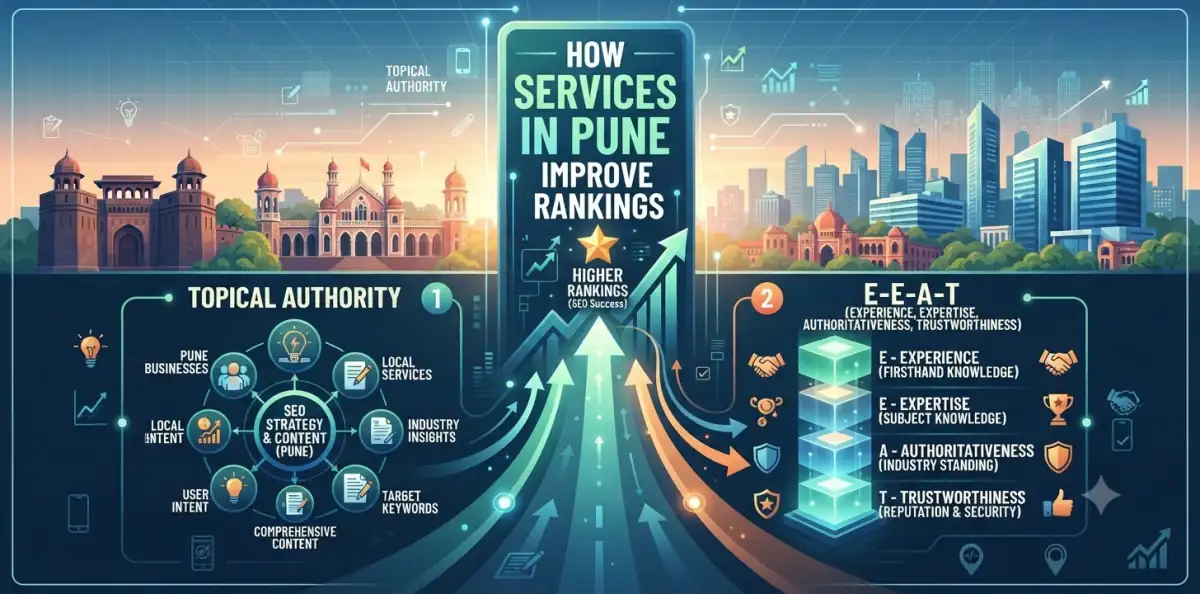
The old approach of stuffing keywords onto a page and building random backlinks doesn't hold up anymore. What works now is building real topical authority and proving that your website meets Google's EEAT standards Experience, Expertise, Authoritativeness, and Trustworthiness. Below, I'll break down what that means in plain, practical terms, and how a thoughtful local approach uses these ideas to grow traffic that actually converts into paying customers, not just passing visitors. Business owners searching for SEO Services in Pune are often looking for exactly this kind of long-term thinking rather than a quick, temporary fix.
1. What EEAT Really Means for Your Website
EEAT isn't a ranking algorithm you can hack, it's a framework Google's quality raters use to judge whether content is worth showing to real people. Here's what each part means for a local business owner, based on patterns we've noticed across dozens of client sites over the years of working in this space.
Experience
Has the person writing this actually done the thing they're talking about? A plumber writing about pipe repairs from firsthand jobs reads very differently from a copywriter who's never touched a wrench. Search engines increasingly pick up on this difference through tone, specificity, and the small practical details that only someone with genuine hands-on experience would think to mention.
Expertise
Does the content show real depth and correct information, not just surface-level filler? A page that answers a question fully, with context and nuance, tends to hold visitors longer and earn more trust than a page that skims the surface and moves on.
Authoritativeness
Do other trusted sources, customers, and industry voices treat this business as a go-to name in its field? This is built slowly, through mentions, citations, reviews, and genuine recognition rather than paid shortcuts or link farms.
Trustworthiness
Is the site secure, transparent, and honest about who runs it, what it offers, and how customers can reach it? Clear contact information, an accurate about page, and honest pricing all play a part here, along with policies that are easy to find and easy to understand.
Google weighs all four together, and no amount of technical polish can fully make up for weak content that fails this test. This is exactly why teams offering SEO Services in Pune now spend as much time on content quality and author credibility as they do on backlinks or site speed, because the two simply can't be separated anymore.
2. Why Topical Authority Matters More Than Single Keywords
Topical authority is the idea that Google trusts websites that cover a subject thoroughly, not just websites that happen to rank for one lucky keyword. If your site has ten thin pages scattered across unrelated topics, Google has little reason to see you as an expert in any one of them, no matter how well each individual page is optimised.
A stronger approach is to build content clusters a detailed core page on a topic, supported by several related articles that link back to it and to each other. For example, a Pune-based interior design firm shouldn't just publish one page titled "interior designer in Pune." It should also cover related questions: modular kitchen costs, small apartment design ideas, material choices suited to Pune's climate, and maintenance tips for different finishes used in local homes. Over time, this network of connected content signals to Google that the site genuinely understands the subject, which naturally improves organic search visibility across many related search terms, not just one isolated phrase.
This is also one of the most practical answers to a common question business owners ask: how do you actually improve rankings in a sustainable way? Instead of chasing isolated keywords, the better path is building genuine depth around the topics your customers actually search for, one well-researched page at a time, rather than one keyword at a time. Businesses that treat this as a slow, deliberate process tend to see stronger organic search visibility a year later than those chasing quick wins.
Topical authority also compounds. Once Google recognises a site as a strong source on a subject, newer pages on related topics tend to rank faster than they would on a site starting from scratch. This is one of the underrated benefits of consistent, focused content over scattered, one-off posts, and it's a large part of why organic search visibility tends to snowball once a site crosses a certain threshold of depth.
3. Building a Strategy That Actually Works for Pune Businesses
Pune has a mix of established industries — IT, manufacturing, education, real estate, and a fast-growing services sector. A one-size-fits-all national SEO plan often misses what local searchers are really looking for. An effective SEO Strategy for Pune Businesses usually includes a few core pieces:
- Local intent research — understanding how people in Pune phrase their searches, including neighbourhood names like Kothrud, Baner, Hinjewadi, or Viman Nagar, and how those terms shift depending on the service being searched for.
- Google Business Profile optimisation — accurate categories, updated photos, and consistent, timely responses to reviews, both positive and negative.
- Localised content — pages and articles that reflect Pune-specific context, pricing, or regulations rather than generic copy borrowed from elsewhere and lightly edited.
- Author bios and credentials — showing who's actually writing the content, along with their real experience in the field they're writing about.
- Consistent NAP data — Name, Address, and Phone number matching exactly across directories, maps, and citations, since mismatches quietly erode trust signals.
None of these steps work well in isolation. It's the combination of local relevance, real expertise, and consistent trust signals that moves the needle over time, and this combined approach is what separates a genuine SEO Strategy for Pune Businesses from generic templates copied off the internet and applied without any local context.
A well-run SEO Strategy for Pune Businesses also adapts over time. What worked to attract customers in Kothrud two years ago may not work the same way today, especially as more competitors enter the same search results and raise the overall quality bar.
4. Practical Basics That Apply to Any Local Business
Whether you run a clinic, a restaurant, or a manufacturing unit, certain fundamentals apply regardless of industry:
- Write like you know the subject, because you should. Reviewed content from someone with real experience always performs better than generic, generated filler that reads the same on every competitor's site.
- Earn links naturally. Getting mentioned by local news sites, industry associations, or community blogs carries more weight than buying links from unrelated sites in bulk.
- Keep technical SEO clean. Fast loading pages, mobile-friendly design, and clear site structure remove barriers between your content and its ranking potential, no matter how good the writing is.
- Update old content regularly. Google notices when a page hasn't been refreshed in years, especially for topics where facts, prices, or regulations change often.
- Collect genuine reviews. Customer reviews remain one of the simplest, most honest trust signals a business can build, and they feed directly into how trustworthy a site appears to both users and search engines.
These basics form the backbone of SEO Strategies for Local Businesses across almost every sector, from healthcare to hospitality to home services. None of these tactics are complicated on their own, but they require consistency over months, not days. Most businesses that struggle with rankings aren't missing a secret trick — they're missing follow-through over a long enough stretch of time to actually see results.
It's worth repeating that SEO Strategies for Local Businesses only work when they're applied steadily. A burst of activity for two weeks followed by six months of silence rarely produces lasting rankings, because Google rewards consistency as much as quality.
What makes SEO Strategies for Local Businesses different from broader national campaigns is the level of specificity involved real neighbourhood names, real local pricing context, and real familiarity with how customers in that particular city actually search and decide.
5. How This Translates Into Long-Term Visibility
Improving how often your business appears in search results isn't a one-month project. It's the result of steady, honest work: publishing content that reflects real experience, organising it around clear topics, and earning trust signals from genuine sources rather than shortcuts. Businesses that commit to this approach usually see slower initial movement but far more stable, long-lasting rankings the kind that don't disappear after the next algorithm update rolls out.
If you're wondering how to improve website rankings with SEO in a way that lasts, the honest answer is that there's no shortcut around expertise, structure, and trust. Tools and technical fixes help, but they support the foundation rather than replace it.
Anyone promising instant results through how to improve website rankings with SEO tricks alone is usually setting a business up for a short-lived spike followed by a longer decline. The businesses that ask how to improve website rankings with SEO and actually stick with the unglamorous, steady work tend to be the ones still ranking well a few years later.
6. Choosing the Right Kind of Support
Not every business needs the same level of outside help, and it's worth being honest with yourself about where the gaps actually are before signing any contract. Some owners are perfectly capable writers who simply lack time to publish consistently. Others have plenty of time but struggle with the technical side of things — page speed, structured data, or fixing crawl errors that quietly hold a site back without ever showing up as an obvious problem on the surface.
When evaluating outside help, ask to see real examples of past work rather than just screenshots of ranking positions, since rankings alone don't tell you whether that traffic actually turned into paying customers. Ask how content gets written whether it's produced by someone who understands the industry, or generated quickly and never properly reviewed. Ask what happens if a particular tactic stops working, since strategies that rely on a single trick tend to collapse the moment Google adjusts its systems, while approaches built on genuine quality tend to hold steady through most updates.
It's also reasonable to ask for a written explanation of what won't be done. A trustworthy partner will be upfront about which shortcuts they refuse to use, even if a competitor offers something that sounds faster or cheaper. That kind of transparency is itself a small but telling signal of the same trustworthiness principle that Google is trying to reward in the content itself.
7. A Realistic Timeline for Results
Setting the right expectations early avoids a lot of frustration later. In the first month, most of the visible work is foundational fixing technical issues, cleaning up listings, and laying out a content plan. It rarely produces dramatic ranking movement on its own, though it removes barriers that would otherwise limit everything that follows.
Between months two and four, freshly published content typically starts getting indexed and tested by Google against existing pages on similar topics. This is usually when the first small ranking movements become visible, though they can be inconsistent week to week as the algorithm continues evaluating the new pages against established competitors.
From month five onward, if the work has been consistent, patterns tend to become clearer. Pages that reflect real depth and genuine expertise typically settle into stronger, more stable positions, while thinner or rushed content either plateaus or slips further down. This is usually the stage where a business can look back and clearly see which parts of the strategy earned their place and which need to be revisited or replaced with something more substantial.
Beyond the six-month mark, the focus shifts from initial growth to protecting and compounding what's already been built refreshing older pages, expanding into adjacent topics, and continuing to earn the kind of genuine recognition that keeps a site's credibility intact through future algorithm changes.
8. Final Thoughts
Google's ranking systems have matured to the point where genuine expertise and consistent trust-building outperform quick fixes almost every time. For businesses in Pune, this means the smartest path forward isn't chasing shortcuts it's investing in content that reflects real experience, structuring that content around clear topics, and building the kind of credibility that keeps customers and search engines coming back. Done consistently, this is what turns a struggling website into one that ranks, and stays ranked, for the long run.