
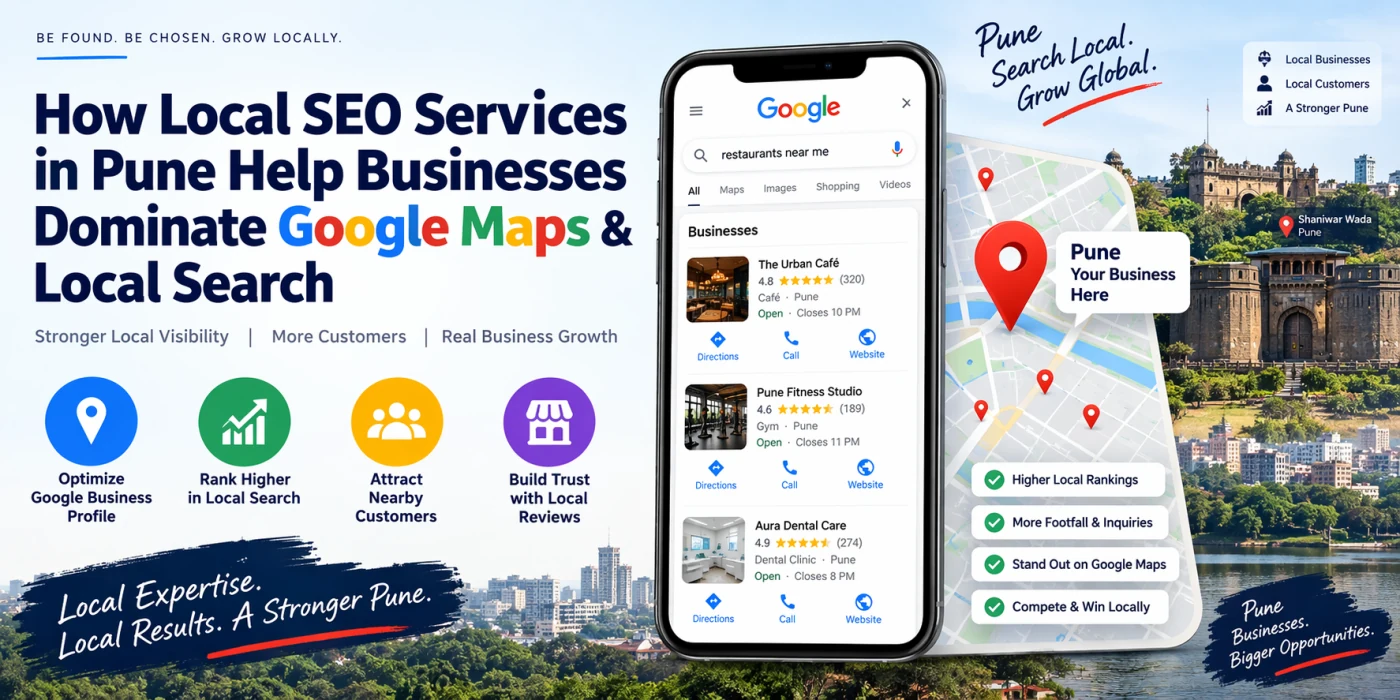
If you've ever searched for "plumber near me" or "best cafe nearby" on your phone, you already know how much Google Maps shapes which businesses actually get chosen. For a business owner in Pune, showing up in that map pack — the three listings that appear right below the search bar — often matters more than ranking on page one of regular search results. This is exactly the gap that good Local SEO Services in Pune are built to close.
Unlike traditional SEO, which focuses mostly on website content and backlinks, local search runs on a different mix of signals: your Google Business Profile, your reviews, your proximity to the searcher, and how consistently your business information appears across the web. Understanding this mix is the first step toward dominating both the Maps pack and the local organic results underneath it.
1. Why Google Maps Rankings Work Differently:
Google Maps rankings mainly depend on three key factors: relevance, distance, and prominence. Relevance means how well your business profile matches what someone searched for. Distance is fairly self-explanatory: a customer searching from Kothrud is more likely to see a business based in or near Kothrud than one on the other side of the city. Prominence is where a real Google Maps SEO Strategy for Pune Businesses makes the biggest difference, since it reflects how well-known and trusted your business appears to be, based on reviews, citations, and overall web presence.
Because of this, two businesses offering the exact same service can see very different results in the map pack, simply because one has invested time into their profile and reputation while the other hasn't touched it since setting it up.
2. What Actually Improves Local Search Visibility:
Building this kind of presence isn't about one single fix; it's a combination of smaller, consistent efforts that add up over time. The most impactful ones include:
- A fully completed Google Business Profile — accurate business hours, categories, service areas, and photos that are updated regularly rather than left from years ago.
- Consistent NAP information — your Name, Address, and Phone number should match exactly across your website, directories, and social profiles, since inconsistencies quietly confuse Google's local algorithm.
- Genuine customer reviews — both the number of reviews and how recently they were left play a role, along with how the business responds to them.
- Location-specific content — pages that mention real neighbourhoods, landmarks, and local context, rather than generic city-wide claims.
- Local backlinks and citations — mentions from Pune-based directories, news sites, or industry associations carry more local weight than generic national links.
Businesses that treat these as ongoing habits, not a one-time setup, tend to see steadier month-on-month improvements in how easily nearby customers can find them.
3. How to Rank on Google Maps for Local Search: A Practical Approach:
If you're aiming to move up in the map pack without hiring an expensive agency, the good news is that most of the groundwork is genuinely within reach for any business owner willing to put in consistent effort.
Start by claiming and fully verifying your Google Business Profile if you haven't already — an unverified or incomplete profile that rarely competes well against verified, detailed ones. Next, choose your primary and secondary categories carefully, since miscategorised listings often struggle to show up for relevant searches even when everything else is in order.
From there, focus on collecting reviews naturally by simply asking satisfied customers at the right moment, rather than through bulk requests that can look suspicious to Google's systems. Respond to every review, positive or negative, since active engagement signals that a real business is actively managing its presence.
Finally, keep your profile active. Posting occasional updates, adding new photos, and answering questions on your listing all contribute small but real signals that your business is genuinely operating and engaged, not just sitting on the map as an outdated entry.
4. Local SEO Strategies for Small Businesses on a Limited Budget:
Not every business has the budget for a full-scale campaign, and that's fine; many of the most effective local moves cost time rather than money.
Start with the basics: a complete, accurate Google Business Profile, a handful of well-written local pages on your website, and a steady stream of genuine reviews. These three things alone put most small businesses ahead of competitors who've never touched their listing beyond the initial setup.
From there, look for easy local partnerships — getting listed on a local chamber of commerce site, a community blog, or even a neighbourhood business directory can quietly build the kind of local relevance that Google rewards. None of this requires a large team or a big budget, just consistent attention over several months.
5. Common Local SEO Mistakes That Cost Businesses Visibility:
Even businesses that understand the basics often lose ground to a handful of avoidable habits.
- Duplicate or unmanaged listings. Over time, businesses sometimes end up with two or three versions of the same Google Business Profile, often created accidentally by different employees or during a rebrand. Google tends to dilute ranking signals across duplicates rather than concentrating them in one strong listing, so consolidating everything into a single verified profile is usually one of the fastest wins available.
- Keyword-stuffed business names. Adding extra descriptive words to a business name field, beyond the actual registered name, might look like a shortcut, but Google's guidelines explicitly prohibit it, and profiles caught doing this risk suspension entirely.
- Ignoring photo quality and freshness. Listings with a handful of blurry, years-old photos tend to get skipped over in favour of competitors showing recent, genuine images of their space, staff, or work. Photos are also one of the easiest things for a business owner to update regularly without any technical help.
- Treating reviews as one-directional. Collecting reviews without ever responding to them wastes half their value. A thoughtful reply, even to a short review, signals to both future customers and to Google that the business is actively engaged with its audience.
6. How to Prioritise When You're Short on Time:
Not every business can tackle everything at once, and trying to do so often means nothing gets done properly. A more realistic approach is to work through priorities in order of impact.
Start with profile completeness, since an incomplete listing undermines every other effort that follows. Once that's solid, shift attention to review generation, since this tends to produce the most visible movement in a relatively short window. From there, focus on consistency — making sure your business information matches everywhere it appears online. Only after these fundamentals are in place does it make sense to invest heavily in additional local content or outreach, since that work performs far better once the foundation underneath it is already solid.
7. Why This Matters More in a City Like Pune:
Pune's mix of established neighbourhoods and rapidly growing areas means local competition is fierce in almost every category, from home services to healthcare to hospitality. A business that ignores this side of search often loses customers not because its service is worse, but simply because it's harder to find at the exact moment someone nearby is searching for it.
This is where working with an experienced local team genuinely pays off — not because of any secret trick, but because someone familiar with the city's search patterns, neighbourhood names, and local competition can move faster and avoid common missteps that cost smaller businesses months of visibility.
8. Final Thoughts:
Dominating Google Maps and local search isn't about outsmarting Google — it's about giving it every reason to trust that your business is real, active, and relevant to the people searching nearby. A complete profile, genuine reviews, consistent information, and steady local content will do more for your rankings than any shortcut ever could.