
Search has changed forever. In 2024, ChatGPT crossed 180 million monthly users, and by 2026, AI-powered search engines like ChatGPT, Perplexity, and Google's AI Overviews are handling billions of queries every single day. Right now old SEO rules still matter but are no longer enough.
If your website is not showing up in AI-generated answers, you are losing traffic, leads, and revenue to competitors who have already adapted.
This guide will show you exactly how to rank in ChatGPT search results, while also covering the broader world of AI Search Optimization, including Google AI Overview Optimization, Perplexity, and Gemini. Whether you are a business owner, marketer, or content strategist, you will walk away with a clear, actionable roadmap.
What Is AEO and GEO — And Why Do They Matter in 2026?
Answer Engine Optimization (AEO):
AEO Services focus on structuring your content so that AI systems can extract and present it as direct answers. If any user asks to chatGPT, "What is the best CRM for a small business?", the AI pulls its answer from pages that are clearly structured, authoritative, and factually accurate.
AEO is about becoming the source that AI trusts.
Generative Engine Optimization (GEO):
GEO Services take this a step further. Generative Engine Optimization means optimizing your content to appear inside AI-generated responses not just in a ranked list of links, but woven directly into the answer the AI produces.
A 2024 study by Princeton, Georgia Tech, and The Allen Institute found that including statistics, citations, and quotations in content increased visibility in AI-generated responses by up to 40%. That is the power of GEO.
AEO vs. SEO vs. GEO: A Quick Comparison
| Feature | Traditional SEO | AEO | GEO |
|---|---|---|---|
| Goal | Rank on Google Page 1 | Appear in featured snippets & AI answers | Be cited inside AI-generated content |
| Focus | Keywords & backlinks | Structured Q&A, schema markup | Authority signals, statistics, citations |
| Search Engine | Google, Bing | ChatGPT, Perplexity, Google AI Overviews | ChatGPT, Gemini, Claude, Perplexity |
| Content Format | Long-form articles | Concise, direct answers | Data-rich, expert-led content |
| Key Metric | Organic rankings | Answer box appearances | AI citation frequency |
How AI Search Engines Decide What to Show
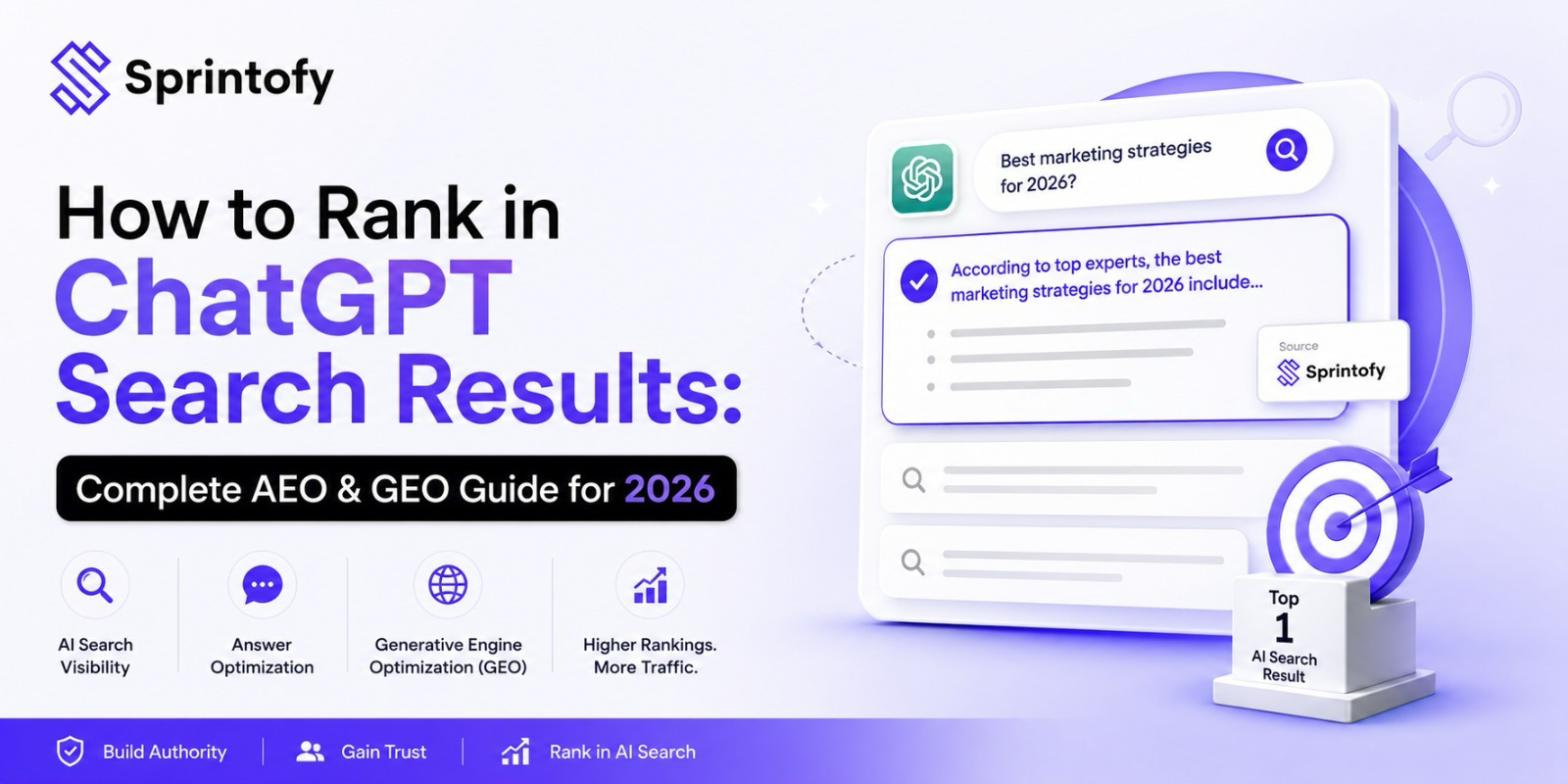
Before you can optimize, you need to understand how AI search engines like ChatGPT actually choose their answers.
AI models are trained on massive datasets, but when they search the live web (as ChatGPT does via Bing), they look for:
- Relevance — Does the page directly answer the query?
- Authority — Is the source credible and well-cited?
- Clarity – The content should be easy to read and understand, with clear headings, proper formatting, and organized information.
- Freshness — Is the information current and up-to-date?
- E-E-A-T signals — Experience, Expertise, Authoritativeness, and Trustworthiness (Google's framework, but adopted broadly by AI systems).
Businesses investing in professional AI Search Optimization are already seeing measurable gains in AI-generated referral traffic. The window to act early is still open but it is closing.
Step-by-Step Guide: How to Rank in ChatGPT Search Results
Step 1: Conduct AI-Focused Keyword Research
Traditional keyword research targets exactly what people are typing into google search boxes. AI search optimization targets conversational queries full of questions, not just phrases.
- Use tools like AlsoAsked, AnswerThePublic, and ChatGPT itself to find natural language questions in your niche.
- Map each question to a specific page or blog post on your site.
- Prioritise long-tail, intent-driven queries: "What is the best way to...", "How does X work?", "Why should I use..."
Step 2: Structure Content for Direct Answers
AI engines reward content that gets to the point immediately.
- Place the direct answer in the first 40–60 words of every section.
- Use H2 and H3 headings that mirror common questions.
- Add a TL;DR or summary box at the top of long articles.
- Break content into short, scannable paragraphs (2–3 sentences max per paragraph).
Step 3: Implement Schema Markup
Structured data is the language AI engines speak. For Google AI Overview Optimization, these schema types are essential:
- FAQPage — for FAQ sections
- HowTo — for step-by-step guides
- Article — for blog posts and news
- Organization — for brand authority signals
- BreadcrumbList — for site structure
Check your schema markup using Google's Rich Results Test and Schema.org tools to make sure it is added correctly and working properly.
Step 4: Build Topical Authority
AI models trust sources that cover a topic deeply and consistently. A single great article is not enough.
- Build content clusters: a pillar page on a broad topic, supported by 8–12 detailed sub-pages.
- Link between related content using natural anchor text.
- Cover the topic from multiple angles informational, commercial, and transactional.
If you invest in professional SEO and Digital Marketing services, topical authority building should be a core deliverable.
Step 5: Earn High-Quality Backlinks and Citations
Backlinks remain a trust signal for AI, just as they do for traditional SEO. But in 2026, brand mentions and unlinked citations also matter because AI models scan the broader web, not just hyperlink graphs.
- Get featured in industry publications, podcasts, and roundups.
- Publish original research or data that others naturally cite.
- Build your presence on authoritative directories and platforms.
Step 6: Optimise for E-E-A-T
AI systems are trained to avoid low-quality or misleading content. To signal expertise and trustworthiness:
- Add a short author profile to each article, including their experience, skills, and qualifications.
- Include real data, statistics, and case studies.
- Cite reputable external sources (without over-linking).
- Keep content updated AI models can detect stale information.
Step 7: Improve Page Speed and Technical SEO
Even the best content will be ignored if your site is slow or technically broken. Fast-loading, well-crawled pages are more likely to be indexed by AI search engines.
- Aim for a Core Web Vitals score of 90+ on PageSpeed Insights.
- Fix broken internal links and redirect chains.
- Keep your sitemap updated and submit it to major search engines so they can easily find and index your website pages.
Investing in Web Development services that prioritise technical performance is one of the highest-ROI moves you can make for AI visibility.
AEO & GEO Optimisation Checklist for 2026
Review this checklist before publishing any content to make sure everything is complete and optimized:
Key Takeaways
- AI search engines like ChatGPT, Perplexity, and Gemini are now primary discovery channels not just Google.
- AEO Services help you become the trusted source AI pulls answers from.
- GEO Services ensure your content is cited and woven into AI-generated responses.
- Structured data, topical authority, E-E-A-T signals, and conversational content are the four pillars of AI search success.
- Google AI Overview Optimization requires the same principles — clarity, authority, and schema markup.
- Businesses that act in 2026 will build a durable competitive advantage before this space becomes saturated.
Frequently Asked Questions (FAQs):
1. How can I make my website appear in ChatGPT search results?
To rank in ChatGPT search results, structure your content to answer specific questions directly, implement schema markup (especially FAQPage and HowTo), build topical authority through content clusters, and earn citations from reputable sources. ChatGPT prioritises clear, credible, and well-structured content when generating responses.
2. What is the difference between AEO and GEO?
AEO (Answer Engine Optimization) focuses on getting your content selected as the direct answer by AI engines. GEO (Generative Engine Optimization) focuses on getting your brand or content cited within AI-generated responses. Both are essential for visibility in tools like ChatGPT, Perplexity, and Google AI Overviews.
3. Does traditional SEO still work in 2026?
Yes, traditional SEO still works and remains important for Google rankings. However, it must now be combined with AEO and GEO strategies to capture visibility across AI-powered search engines. Think of traditional SEO as the foundation, with AEO and GEO as the next layer of optimisation.
4. How does Google AI Overview Optimization differ from standard SEO?
Google AI Overview Optimization requires the same technical SEO foundations but prioritises structured answers, schema markup, E-E-A-T compliance, and content that directly addresses user intent. Google's AI Overviews pull from content that is authoritative, concise, and clearly organised — not just the highest-ranking pages.
5. How long does it take to rank in AI search results?
Results vary, but most businesses see initial improvements in AI citation frequency within 60–90 days of implementing AEO and GEO best practices. Building lasting topical authority — the strongest signal for AI engines — typically takes 6–12 months of consistent, high-quality content creation.
Conclusion
The rise of AI search is not a trend, it is a permanent shift in how people find information, make decisions, and discover businesses. Brands that understand how to rank in ChatGPT search results today will dominate their niches tomorrow.
The good news? The playbook is clear. Structured content, topical authority, schema markup, and genuine expertise are the keys to being chosen by AI engines over your competitors.
Ready to get ahead of the curve? Explore our professional AEO Services, GEO Services, and AI Search Optimization solutions to start building your AI search presence today. Or speak to our team about a full Digital Marketing strategy tailored to the AI-first search landscape.